PRACTICAL GUIDE FOR SCREEN TIME

In today’s world, screens are everywhere, and digital devices have become a natural part of daily life for both adults and children. They help us learn, connect, and stay entertained. However,
alongside these benefits comes an important question.
How much is too much, and how do we create balance?
This manual is designed to help parents navigate screen time in a way that is realistic, practical, and sustainable, especially within busy schedules and everyday parenting demands.
Many parents feel stuck in a cycle of repeating instructions, negotiating limits, and using screens to manage behavior and often leading to frustration and inconsistency.
This manual is not about removing screens or striving for perfection. Instead, it offers a balanced approach to:
- Set clear and consistent boundaries
- Reduce daily power struggles
- Build healthier habits for your child
- Stay calm and confident as a parent
This guide will help you move from:
- Reaction to Response
- Chaos to Structure
- Conflict to Connection
You don’t need more time to be a mindful parent.You need a clear approach that works within the time you already have.
Why Children Get Addicted to Screens
They get hooked because screens are designed to capture attention and often fill an unmet
need. Fast visuals, instant rewards, and endless content make screens more stimulating than real-life activities, especially for young minds still developing self-control.
When screens are always available, they quickly become the default. Without clear limits, occasional use turns into habit, and then dependence.
Screens can also become emotional crutches, replacing opportunities to build patience and self-regulation. At the same time, they often take the place of what children truly need: connection, play, and creativity.
In simple terms, screen dependence is shaped by design, habit, environment, and guidance.
Common Mistakes Parents Make
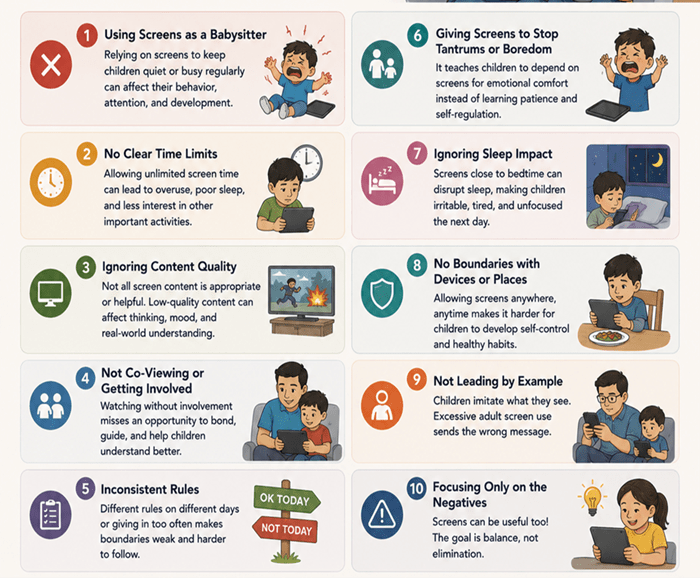
Managing screen time isn’t always difficult because parents lack knowledge. It is often because of inconsistency, pressure, and daily habits. In the rush of everyday life, it’s easy to fall into patterns that feel convenient in the moment but create challenges over time
Understanding these mistakes is the first step to creating calm and clarity around screen time.
Some Mistakes by Parents: –
- Giving devices to avoid conflict
- Inconsistent rules
- Threatening but not following through
- Allowing screens before bedtime
- Using screens as rewards all the time
- Expecting children to self-regulate too early
- Parents using phones constantly while asking children not to
Why Age Matters in Managing Screen Time
Screen time isn’t one-size-fits-all. Age and development matters.
Under 2: minimal screens, focus on real-world interaction.
Ages 2–5: limited, high-quality content with guidance.
School-age: focus on balance so screens don’t affect sleep, learning, or wellbeing.
Guidelines
Under 2 Years :- Avoid passive screen exposure. Prioritize human interaction.
Ages 2–5:- Limit recreational screen time. Choose educational, interactive content. Supervise usage
School-Age Children:- Balance Sleep Emotional wellbeing Academic responsibilities Offline activities
In simple terms: the younger the child, the greater the need for protection and limits; the older the child, the greater the need for guidance and balance.
Why Structure Matters
Children thrive on routine. Just as they have set times for sleep, meals, and school, they also need clear and consistent boundaries around screen use. When expectations are predictable, children feel more secure,and resistance naturally reduces.
Strictness may bring short-term compliance, but often leads to power struggles. Consistency builds trust. When rules are followed calmly and repeatedly, children begin to understand:
this is how things work.
Inconsistent rules create confusion. But when screen time follows a clear pattern, like “after homework” or “for a fixed time”, daily negotiation reduces.
Structure doesn’t mean rigidity.
It means simple, reliable guidelines applied calmly.
Consistency also helps children develop self-regulation, as they learn to manage their behavior within clear limits.
For busy parents, the focus is simple:
- Set clear expectations
- Follow through calmly
- Repeat consistently
In the end, it’s not strictness that shapes behavior—it’s how steady and predictable you are.